


The system at a glance
Every day, the Milwaukee system treats upwards of 150 million gallons of wastewater. The journey has four stages: wastewater is collected from homes and businesses across the service area; during rain events it can be held in the Deep Tunnel inline storage system; it is treated at the Jones Island and South Shore reclamation facilities to strict environmental standards; and the cleaned water is returned to Lake Michigan.
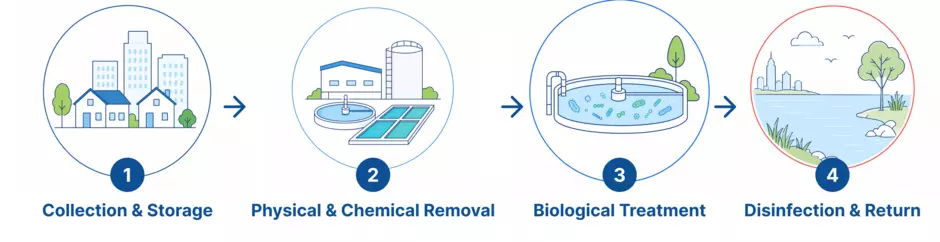
Milwaukee Wastewater Treatment Process - 4 Steps:
Collection & Storage - Wastewater from homes and businesses travels through the conveyance system to Jones Island or South Shore (150+ million gallons per day between the 2 plants), with excess stored in the Deep Tunnel system during rain events.
Physical & Chemical Removal - Large objects are screened out, and grease, oil, and solids are separated in settling tanks; solids are converted to energy. (this will need a new graphic between existing #1 collection and #2 treatment graphics)
Biological Treatment - Microscopic organisms break down organic material and are later dried to create Milorganite®, a nationally-sold fertilizer.
Disinfection & Return - Disease-causing organisms are eliminated through chemical disinfection, and the cleaned water is safely returned to Lake Michigan.
Our facilities
Jones Island Water Reclamation Facility
Jones Island treats wastewater and recovers resources, including the production of Milorganite® fertilizer - one of the longest-running resource-recovery operations of its kind in the country.
South Shore Water Reclamation Facility
South Shore treats wastewater and digests biosolids to recover energy. A multi-year reconstruction of the facility's aeration basins is under way - a major capital upgrade that will increase long-term treatment capacity and performance.
The Deep Tunnel
The Deep Tunnel is a 28.5-mile inline storage system. During rain events it holds combined stormwater and sewage underground until it can be treated, which helps prevent basement backups and reduce overflows. Together with the treatment plants, it is central to how the system responds to wet weather.
Operating during rain events
Veolia operates the system in coordination with MMSD to maximize treatment capacity and minimize basement backups during rain events, while staying within strict environmental permit limits. During significant storms, the system can reach physical and regulatory limits because of very high inflows and because of ongoing capital improvements at both plants.
To address this, MMSD is investing in major upgrades, such as the multi-year reconstruction of South Shore's aeration basins, to increase long-term capacity.
Before and during every rain event, Veolia and MMSD jointly monitor conditions across the whole system - including the Deep Tunnel and the treatment facilities - and coordinate operations in real time. The priorities are consistent: minimize overflows and basement backups and protect water quality. When extreme conditions require system-level decisions, MMSD retains final authority.
Maintenance approach
Maintenance is proactive, data-driven and fully coordinated with MMSD. The contract with MMSD holds Veolia to strict performance standards, with accountability for equipment reliability and penalties for missing obligations.
Veolia applies the most stringent industry standards, including original-equipment-manufacturer recommendations, and uses a Reliability-Centered Maintenance (RCM) approach that often goes beyond those recommendations based on the criticality, risk and redundancy of equipment. Both organizations have added dedicated maintenance and engineering roles.
Year over year, preventive maintenance completion for critical assets within 45 days is greater than 95%, and about 70% of maintenance labor is dedicated to preventive activities. MMSD has full visibility into maintenance records.